

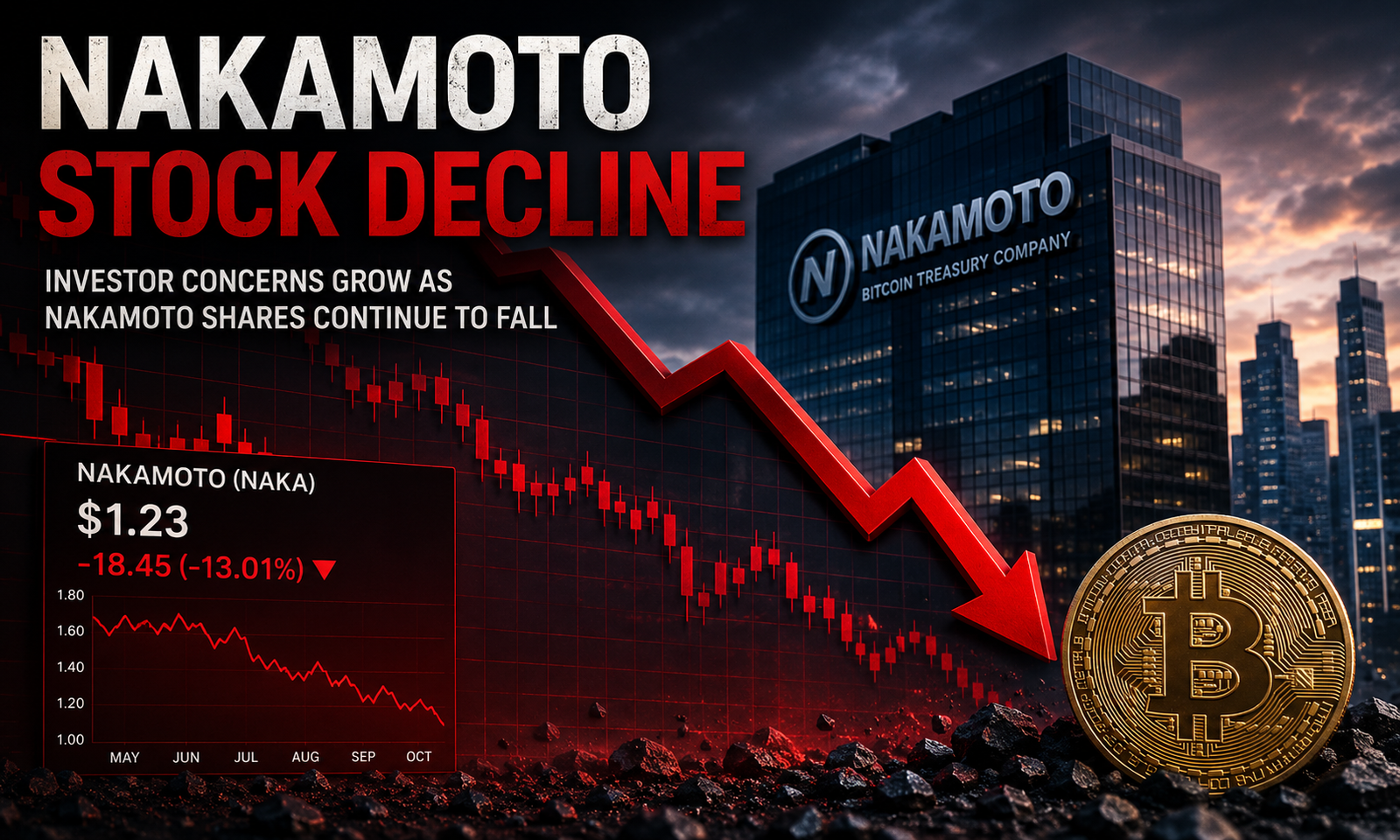
The cryptocurrency market has entered a new phase where corporate Bitcoin holdings are becoming just as important as blockchain innovation itself. Over the past few years, several companies have transformed their balance sheets by adding Bitcoin reserves, hoping to benefit from long-term price appreciation and increased investor attention. Among the firms making headlines recently is Nakamoto, a growing Bitcoin treasury company now taking strategic action to prevent a significant decline in its stock price.
As market volatility intensifies and investor confidence fluctuates, companies linked to digital assets are under increasing pressure to prove the sustainability of their business models. For Nakamoto, the challenge is not only maintaining its Bitcoin reserve strategy but also convincing shareholders that its long-term vision remains strong despite short-term turbulence. The company’s latest moves to stabilize its stock have sparked intense discussion across the crypto sector, financial media, and institutional investment circles.
The story of Bitcoin Treasury Company Nakamoto Takes Action To Prevent Stock Slide is more than a single corporate event. It reflects the broader evolution of crypto-backed companies navigating market uncertainty while trying to capitalize on the growing institutional adoption of Bitcoin. Investors are closely analyzing how treasury firms manage risk, preserve shareholder value, and respond to sudden price swings in both Bitcoin and equity markets. This article explores the company’s recent actions, the reasons behind the stock pressure, the impact on investors, and what the future may hold for Bitcoin treasury businesses in an increasingly competitive financial environment.
The Role of a Bitcoin Treasury Company
A Bitcoin treasury company is a business that allocates a substantial portion of its corporate reserves into Bitcoin rather than traditional cash assets. These companies often believe that Bitcoin provides a stronger long-term hedge against inflation, currency debasement, and macroeconomic instability.
Nakamoto entered this emerging sector with an aggressive treasury accumulation strategy designed to position itself as a leading digital asset-focused enterprise. By linking its corporate identity closely to Bitcoin performance, the company aimed to attract both crypto enthusiasts and institutional investors seeking exposure to BTC through publicly traded equities.
The appeal of these firms is straightforward. Investors can gain indirect exposure to Bitcoin through traditional stock markets without directly purchasing or storing cryptocurrency themselves. However, this structure also creates vulnerability because stock performance becomes highly correlated with Bitcoin price movements and broader crypto sentiment. As Bitcoin experiences volatility, treasury companies often face amplified market reactions. If investors lose confidence in Bitcoin’s short-term trajectory, the associated stock may decline even faster than the cryptocurrency itself.
Why Nakamoto’s Stock Came Under Pressure
The recent concerns surrounding Nakamoto began when investors noticed a sustained decline in the company’s share price despite relatively stable Bitcoin market conditions. Analysts pointed to several factors contributing to the downward momentum.
Market Volatility and Investor Sentiment
The crypto market remains heavily influenced by macroeconomic conditions, including interest rates, inflation data, and global liquidity trends. Even though Bitcoin has matured significantly over the last decade, it still reacts sharply to economic uncertainty. As risk appetite weakened across financial markets, investors began rotating away from speculative assets, including crypto-related equities. This shift negatively impacted companies like Nakamoto whose valuation depends heavily on Bitcoin exposure.
Concerns About Treasury Leverage
Another issue affecting the company involved concerns over leverage and capital management. Some investors worried that aggressive Bitcoin acquisition strategies funded through debt or equity dilution could create long-term financial strain. In the case of Nakamoto, critics argued that relying too heavily on Bitcoin appreciation to support shareholder returns could become risky if BTC entered an extended consolidation or bearish cycle.
Competition in the Bitcoin Treasury Sector
The rise of multiple Bitcoin treasury companies has also intensified competition for investor attention. As more firms adopt similar treasury strategies, differentiation becomes increasingly difficult. Investors now evaluate treasury firms based on operational efficiency, reserve management, corporate governance, and long-term sustainability rather than simple Bitcoin ownership alone. Nakamoto faced pressure to demonstrate why its approach remained superior in a crowded market.
Nakamoto’s Strategic Response to the Stock Slide
Faced with mounting investor concerns, Nakamoto initiated several measures aimed at restoring confidence and preventing further stock deterioration.
Strengthening Treasury Transparency
One of the company’s first moves involved increasing transparency around its Bitcoin holdings and treasury management practices. Investors demanded clearer reporting regarding reserve allocation, acquisition costs, and risk exposure.
By providing more detailed financial disclosures, Nakamoto sought to reassure shareholders that its treasury operations remained disciplined and strategically planned rather than speculative. Enhanced transparency is becoming increasingly important in the crypto corporate sector. Investors want assurance that companies are managing digital assets responsibly while maintaining sufficient liquidity to withstand volatility.
Adjusting Capital Allocation Strategy
Nakamoto also reportedly revised aspects of its capital allocation framework. Instead of pursuing aggressive Bitcoin accumulation at any cost, the company signaled a more balanced approach focused on preserving shareholder value.
This included evaluating operational efficiencies, managing debt exposure, and potentially diversifying certain revenue streams beyond pure Bitcoin appreciation. The market often rewards companies that demonstrate adaptability during uncertain conditions. By showing flexibility, Nakamoto aimed to reduce investor fears about excessive risk-taking.
Investor Communication and Market Confidence
Another important component of the company’s response involved direct communication with investors and analysts. Corporate leadership emphasized its long-term belief in Bitcoin while acknowledging short-term market concerns.
Clear communication plays a major role in stabilizing publicly traded companies during volatile periods. Investors generally respond positively when management openly addresses challenges instead of ignoring them. Nakamoto’s leadership stressed that its Bitcoin-focused strategy remains intact but will evolve alongside changing market conditions.
The Growing Influence of Bitcoin Treasury Strategies
The situation involving Nakamoto highlights a much larger trend in modern finance: the rise of corporate Bitcoin treasury adoption. Over the last several years, Bitcoin has transitioned from a niche digital experiment into a recognized institutional asset. Public companies, hedge funds, and asset managers increasingly view BTC as a strategic reserve asset comparable to digital gold.
Why Companies Hold Bitcoin
Several motivations drive companies to adopt Bitcoin treasury strategies. First, Bitcoin offers scarcity through its fixed supply of 21 million coins. Many corporations see this as protection against inflation and currency depreciation. Second, holding Bitcoin can attract investor attention and media exposure. Companies associated with digital assets often receive heightened visibility within financial markets.
Third, Bitcoin exposure allows firms to align themselves with technological innovation and the evolving decentralized economy. However, the strategy also introduces considerable volatility. Corporate earnings, stock valuations, and investor sentiment can fluctuate dramatically alongside Bitcoin price movements.
Institutional Adoption and Market Evolution
Institutional adoption has significantly influenced how treasury companies operate. Large financial institutions now participate in Bitcoin markets through ETFs, custody services, and digital asset investment products. This institutional involvement has increased market legitimacy while simultaneously raising expectations for professionalism and governance among Bitcoin treasury firms.
The Importance of Corporate Governance
For companies like Nakamoto, governance standards are becoming critical. Investors want to know how decisions regarding Bitcoin purchases, reserve management, and financial risk are made. Strong governance structures help reduce uncertainty and improve market confidence. Weak governance, on the other hand, can amplify investor fears during periods of volatility. Nakamoto’s recent actions suggest the company understands the importance of aligning with institutional expectations.
How Bitcoin Price Movements Affect Treasury Companies
The relationship between Bitcoin prices and treasury company stocks is complex but deeply interconnected. When Bitcoin rallies strongly, treasury firms often outperform traditional equities because investors view them as leveraged exposure to BTC appreciation. However, the reverse is also true during downturns.
Correlation Between BTC and Stock Valuation
Investors typically evaluate Bitcoin treasury firms based on several factors, including:
- Total Bitcoin holdings
- Average acquisition price
- Debt exposure
- Revenue generation
- Market confidence
- Operational sustainability
If Bitcoin prices decline sharply, investors may question whether treasury firms can maintain profitability or avoid balance sheet stress. For Nakamoto, preventing a stock slide required convincing investors that the company could navigate volatility without undermining long-term value creation.
Investor Psychology in Crypto-Linked Stocks
Investor psychology plays an enormous role in the performance of crypto-related equities. Market participants often react emotionally to headlines, price swings, and social media sentiment.
Fear, Uncertainty, and Volatility
Fear and uncertainty can rapidly accelerate selling pressure in Bitcoin treasury stocks. Negative sentiment surrounding Bitcoin frequently spills over into associated companies regardless of their operational fundamentals. This creates an environment where treasury firms must actively manage investor perception alongside actual financial performance. Nakamoto’s decision to address concerns proactively demonstrates awareness of how quickly market narratives can influence valuation.
Long-Term Investor Confidence
While short-term traders focus on volatility, long-term investors tend to prioritize strategic vision and execution. If Nakamoto successfully demonstrates disciplined treasury management, operational resilience, and strong governance, investor confidence could gradually return despite temporary market pressure.
The Broader Impact on the Crypto Industry
The outcome of Nakamoto’s stabilization efforts may influence how other Bitcoin treasury companies approach risk management in the future.
Setting Industry Standards
As more corporations adopt Bitcoin reserve strategies, industry standards regarding transparency, governance, and treasury reporting are likely to become increasingly important. Companies that fail to meet these expectations may struggle to maintain investor trust. Nakamoto’s response could therefore serve as a case study for other firms navigating similar market challenges.
Crypto Market Maturity
The broader crypto industry continues moving toward institutional maturity. Early speculative enthusiasm is gradually giving way to more disciplined financial analysis. Investors now expect crypto-related companies to operate with the same professionalism as traditional public corporations. This shift benefits the long-term credibility of the industry while simultaneously increasing pressure on companies to deliver sustainable performance.
Can Bitcoin Treasury Companies Survive Long-Term?
One of the biggest questions surrounding firms like Nakamoto involves long-term sustainability. Critics argue that treasury companies depend too heavily on Bitcoin price appreciation. Supporters counter that Bitcoin’s long-term scarcity and growing institutional adoption justify corporate reserve strategies.
Diversification and Innovation
The most successful treasury firms may ultimately be those that combine Bitcoin holdings with diversified operational models. Rather than relying solely on BTC appreciation, companies could develop complementary revenue streams such as:
- Blockchain infrastructure services
- Digital asset custody
- Institutional crypto consulting
- Payment technology
- Tokenization platforms
Diversification helps reduce dependence on market cycles while strengthening long-term business fundamentals.
Regulatory Considerations
Regulation will also shape the future of Bitcoin treasury companies. Governments worldwide continue developing frameworks for digital asset taxation, reporting, custody, and compliance. Companies capable of adapting to evolving regulations will likely maintain stronger investor confidence. Nakamoto’s recent emphasis on transparency may partially reflect growing awareness of regulatory expectations.
Market Reactions to Nakamoto’s Actions
Following the company’s response, market analysts began reassessing Nakamoto’s long-term outlook. Some investors viewed the actions positively, interpreting them as evidence of responsible leadership and strategic flexibility. Others remained cautious, arguing that broader crypto market volatility still presents substantial risk.
Analyst Perspectives
Several market observers noted that proactive treasury management is essential for crypto-linked companies operating in unpredictable environments. Analysts emphasized that transparency, communication, and disciplined capital allocation could help treasury firms withstand periods of uncertainty more effectively.
However, they also warned that no corporate strategy can fully eliminate exposure to Bitcoin’s inherent volatility.
The Future of Bitcoin Treasury Companies
The rise of Bitcoin treasury firms represents a significant transformation in how corporations approach reserve management and digital assets.
Increased Institutional Participation
As institutional investors continue entering the crypto sector, treasury companies may gain access to broader pools of capital and more sophisticated financial tools. This could improve risk management capabilities while supporting long-term growth.
Greater Market Scrutiny
At the same time, increased institutional participation brings greater scrutiny. Investors expect transparency, accountability, and consistent execution. Companies unable to meet these standards may face ongoing valuation pressure. For Nakamoto, preventing a stock slide may only be the beginning. Sustaining investor trust will require continued strategic discipline and adaptability.
The story of Bitcoin Treasury Company Nakamoto Takes Action To Prevent Stock Slide reflects the evolving relationship between traditional corporate finance and the rapidly growing cryptocurrency ecosystem. As Bitcoin treasury strategies become more common, companies must navigate the delicate balance between innovation, investor confidence, and financial stability.
Nakamoto’s efforts to stabilize its stock demonstrate how important transparency, governance, and strategic communication have become in today’s crypto-driven markets. While Bitcoin remains a powerful long-term asset for many corporations, market volatility continues to create substantial challenges for publicly traded treasury firms. The company’s future success will likely depend on its ability to combine disciplined financial management with long-term conviction in Bitcoin’s value proposition. Investors will continue watching closely to see whether Nakamoto can transform short-term stabilization efforts into sustainable long-term growth. As the digital asset industry matures, treasury companies like Nakamoto may play an increasingly important role in bridging traditional finance with the decentralized economy. Their success or failure could shape how future corporations approach Bitcoin adoption for years to come.
