

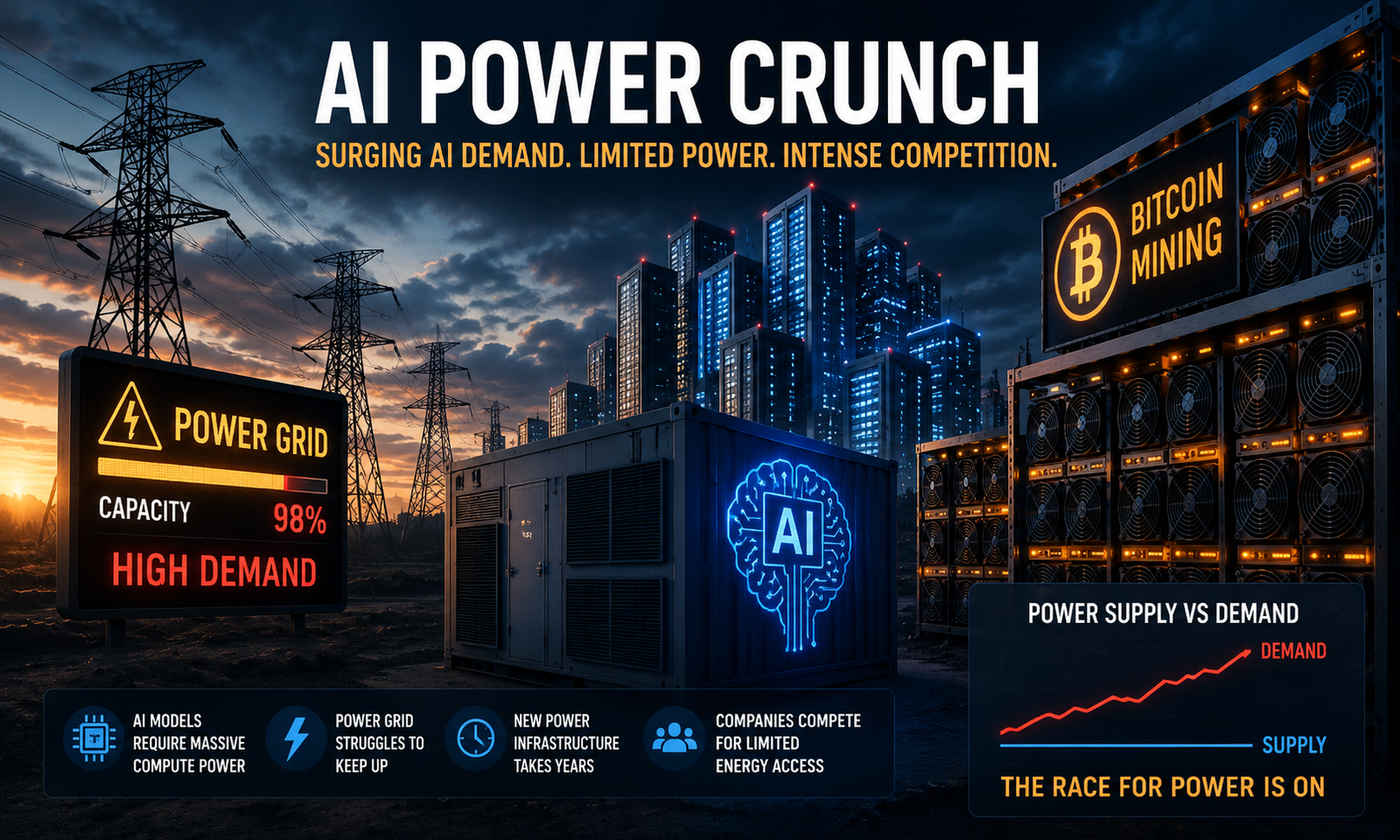
The rapid rise of artificial intelligence (AI) is creating an unprecedented demand for computing power, and with that demand comes an equally significant need for electricity. Around the world, AI companies are investing billions of dollars into new data centers capable of training and running increasingly sophisticated AI models. However, as these facilities expand, one major challenge has emerged: access to reliable electrical power.
Interestingly, this challenge has created an unexpected opportunity for the Bitcoin mining industry. For years, Bitcoin miners focused primarily on securing the blockchain and generating cryptocurrency rewards while often facing criticism over their electricity consumption. Today, that same energy infrastructure is becoming one of their most valuable assets.
The AI power crunch has fundamentally changed how investors, technology firms, and utility companies view Bitcoin mining operations. Instead of being seen merely as energy-intensive crypto businesses, many miners now own strategically located power connections, transmission agreements, substations, and electrical infrastructure that AI companies desperately need.
As demand for AI computing continues to surge, Bitcoin miners are finding themselves at the center of a growing competition for electricity. Their established grid access, energy expertise, and existing facilities are attracting interest from cloud providers, hyperscale data center operators, and AI infrastructure developers. This shift represents a remarkable transformation for the cryptocurrency sector. Rather than relying solely on Bitcoin prices, miners are increasingly exploring partnerships with AI companies, diversifying revenue streams, and repositioning themselves as infrastructure providers in the expanding digital economy.
This article explores why AI’s power crunch turns Bitcoin miners’ grid access into an asset, how this trend is reshaping both industries, and what it means for investors, energy markets, and the future of digital infrastructure.
The AI Power Crunch
The explosive adoption of generative AI has dramatically increased demand for computational resources. Every large language model requires enormous amounts of processing power during both training and inference. These workloads consume significantly more electricity than traditional cloud computing applications.
Major technology companies are spending hundreds of billions of dollars building AI infrastructure. However, constructing a data center is no longer the most difficult part of expansion. Securing adequate electrical capacity has become the biggest bottleneck.
Utilities across North America, Europe, and parts of Asia are struggling to connect new AI facilities because transmission networks are already operating near capacity. Building additional transmission lines often requires years of planning, permitting, and construction. As a result, companies are increasingly searching for locations where electricity is already available—a requirement that perfectly aligns with many Bitcoin mining facilities.
Why Bitcoin Miners Have Become Attractive to AI Companies
Existing Grid Connections Offer a Competitive Advantage
One of the most valuable assets Bitcoin miners possess is their established access to electrical grids. Many mining operations invested years ago in substations, transformers, and high-capacity transmission connections to support large-scale mining farms. Today, these existing connections are becoming significantly more valuable than the mining hardware itself.
Rather than waiting several years for new grid approvals, AI developers can potentially lease or acquire facilities that already have megawatts of available capacity. This dramatically shortens deployment timelines while reducing regulatory uncertainty.
Large Industrial Facilities Are Ready for Conversion
Many Bitcoin mining operations already occupy industrial-scale campuses equipped with cooling systems, networking infrastructure, backup generators, and physical security.
Although AI servers differ from ASIC mining machines, many core infrastructure elements remain useful. This reduces construction costs while accelerating AI data center deployment.
The Growing Value of Grid Access
For years, investors evaluated Bitcoin miners based on metrics such as:
- Bitcoin production
- Hash rate
- Mining efficiency
- Energy costs
- Operating margins
Today, another factor is becoming increasingly important:
Grid-connected power capacity.
Companies with access to hundreds of megawatts of electricity may possess infrastructure worth billions of dollars in future AI partnerships. Some mining firms are discovering that their energy assets command higher valuations than their cryptocurrency operations. This shift illustrates how market conditions can redefine the value of existing infrastructure.
How AI Data Centers Consume Massive Amounts of Electricity
Training advanced AI models requires thousands—or even hundreds of thousands—of specialized GPUs operating continuously. Unlike traditional enterprise servers, AI clusters consume enormous amounts of electricity while generating substantial heat.
Modern AI campuses often require:
High-Density Power Delivery
AI processors consume far more electricity than conventional CPUs. Specialized power distribution systems must deliver consistent energy without interruption.
Advanced Cooling Systems
Heat management has become one of the biggest engineering challenges. Liquid cooling, immersion cooling, and advanced HVAC technologies are increasingly necessary to maintain performance.
Continuous Uptime
Even brief outages can disrupt expensive AI training workloads.
Reliable utility connections are therefore essential.
Bitcoin mining facilities already prioritize many of these operational requirements, making them logical candidates for AI infrastructure redevelopment.
Why Utilities Favor Flexible Bitcoin Mining Operations
One overlooked advantage of Bitcoin miners is operational flexibility. Unlike hospitals or manufacturing plants, mining facilities can quickly reduce electricity consumption when grid demand spikes.
This flexibility allows utilities to balance electricity supply during periods of extreme demand. As AI data centers create additional pressure on electrical networks, utilities increasingly value customers capable of adjusting power usage when necessary.
Some miners are even participating in demand-response programs, temporarily shutting down mining equipment during peak consumption periods. This flexibility strengthens relationships with power providers while improving overall grid stability.
AI Partnerships Are Creating New Revenue Opportunities
Instead of relying entirely on cryptocurrency mining income, companies are exploring diversified business models. Several miners are leasing portions of their facilities to AI infrastructure providers.
Others are constructing dedicated AI data centers alongside mining operations. Some companies are entering long-term hosting agreements where AI customers install their own hardware while miners provide power, cooling, maintenance, and physical security. This diversification helps reduce dependence on Bitcoin market cycles.
The Economics Behind the Shift
Bitcoin Mining Is Highly Cyclical
Mining profitability depends on multiple variables:
Bitcoin Prices
Higher Bitcoin prices generally improve mining revenues.
Network Difficulty
Increasing competition raises mining difficulty, reducing rewards per machine.
Electricity Costs
Energy represents the largest operating expense for most miners.
Because profitability fluctuates significantly, many companies have sought alternative revenue sources. AI infrastructure offers more predictable long-term contracts that can stabilize earnings.
Investors Are Reassessing Bitcoin Mining Companies
Financial markets are beginning to evaluate mining companies differently. Rather than focusing exclusively on cryptocurrency production, analysts increasingly examine:
Power availability
Grid interconnection agreements
Land ownership
Expansion potential
Relationships with utility providers
Mining firms possessing strategic energy infrastructure may receive higher valuations because their assets can support both cryptocurrency mining and AI computing.
Challenges Facing the Transformation
Despite the opportunities, converting Bitcoin mining facilities into AI infrastructure is not straightforward.
Different Hardware Requirements
ASIC miners and AI GPU clusters have very different technical specifications.
Power density, cooling needs, networking architecture, and rack configurations often require extensive modifications.
Significant capital investment is usually necessary before conversion.
Long-Term Electricity Contracts
Some mining operations negotiated electricity agreements specifically for cryptocurrency mining.
These contracts may require renegotiation before facilities can serve AI customers.
Capital Requirements
Building modern AI data centers involves billions of dollars in investment.
Smaller mining companies may struggle to finance large-scale transitions without strategic partners.
Renewable Energy Is Becoming Even More Important
Many Bitcoin miners intentionally located operations near renewable energy sources such as:
Hydroelectric power
Wind farms
Solar facilities
These clean energy sources have become increasingly attractive for AI companies seeking to reduce carbon emissions. Environmental sustainability has become an important consideration for hyperscale cloud providers and enterprise customers. Facilities powered by renewable electricity may therefore enjoy additional competitive advantages.
The Global Competition for Power Infrastructure
Countries worldwide are recognizing that electricity infrastructure has become a strategic economic asset.
Governments are investing heavily in:
- Grid modernization
- Nuclear energy
- Renewable generation
- Transmission expansion
- Energy storage
The race to attract AI investment increasingly depends on available electrical capacity.
Bitcoin miners that secured power years before the AI boom now find themselves holding infrastructure that has become significantly more valuable.
How This Trend Could Reshape the Cryptocurrency Industry
The growing relationship between AI and Bitcoin mining may permanently alter the mining business. Instead of existing solely as cryptocurrency producers, miners could evolve into diversified digital infrastructure companies.
Future revenue may come from:
AI hosting
Cloud computing
High-performance computing
Data center services
Bitcoin mining
This hybrid approach reduces business risk while expanding growth opportunities. Some analysts believe mining companies with strong energy portfolios could become essential partners for the next generation of AI infrastructure.
What Investors Should Watch
Investors evaluating Bitcoin mining companies should increasingly consider infrastructure quality rather than focusing exclusively on Bitcoin production metrics. Important factors include available megawatts, proximity to transmission lines, utility relationships, renewable energy access, expansion potential, and existing data center infrastructure.Companies capable of supporting both cryptocurrency mining and AI computing may be better positioned for long-term growth than miners relying solely on digital asset prices.
The Future of AI and Bitcoin Mining
The convergence of AI and cryptocurrency infrastructure is likely to accelerate over the coming decade. As AI adoption continues expanding across industries, demand for electricity will remain exceptionally strong.
Building entirely new power infrastructure requires significant time and regulatory approvals. Meanwhile, Bitcoin miners already possess many of the critical assets AI companies need today. Rather than competing with AI, many miners are embracing the opportunity by repositioning themselves as energy and infrastructure providers.
This evolution could fundamentally transform public perception of Bitcoin mining—from an energy-intensive activity into an important contributor to next-generation digital infrastructure. The companies that successfully combine AI computing, Bitcoin mining, grid access, and renewable energy may emerge as leaders in both industries.
Conclusion
The rise of AI has created a global power crunch that is reshaping the value of electrical infrastructure. As hyperscale AI data centers compete for limited grid capacity, Bitcoin miners’ grid access has emerged as one of the industry’s most valuable strategic assets. What was once viewed primarily as infrastructure for cryptocurrency mining is now attracting attention from AI developers seeking immediate access to reliable electricity, industrial facilities, and scalable power capacity.
This transformation highlights how rapidly technology markets can evolve. Bitcoin miners are no longer valued solely for their hash rate or cryptocurrency production; they are increasingly recognized for owning energy infrastructure that is difficult and time-consuming to replicate. Through partnerships, hosting agreements, and data center conversions, many mining companies are diversifying beyond digital assets and positioning themselves at the heart of the AI revolution.
As global electricity demand continues to rise, AI’s power crunch turns Bitcoin miners’ grid access into an asset that could shape the future of both artificial intelligence and blockchain infrastructure. Companies capable of combining reliable power, renewable energy, and flexible operations will likely enjoy a significant competitive advantage in the years ahead.
