

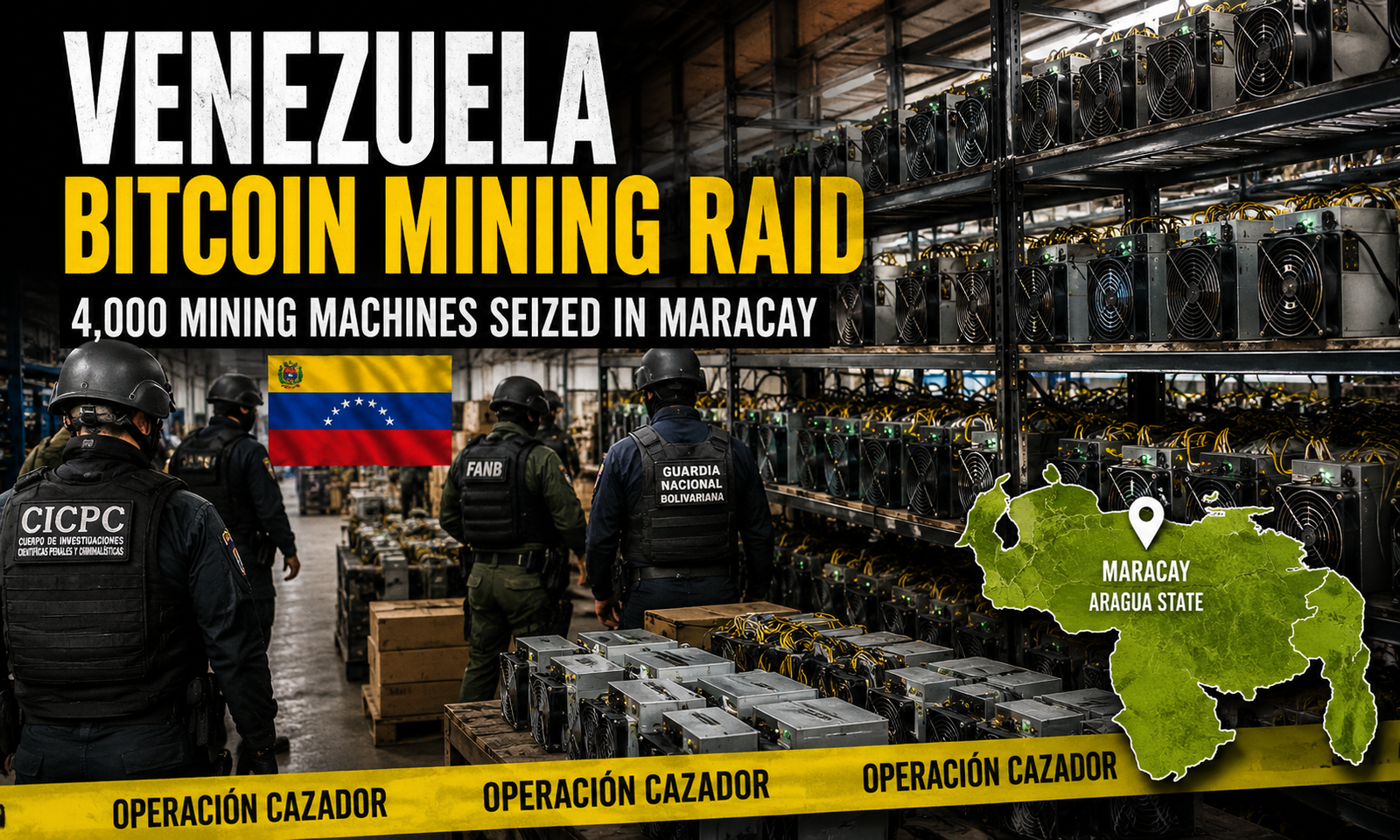
The global cryptocurrency industry continues to face increasing regulatory scrutiny, and the latest development from Venezuela has once again placed Bitcoin mining operations under the spotlight. Venezuelan authorities recently conducted a massive raid in Maracay, confiscating nearly 4,000 Bitcoin mining machines in what officials described as one of the country’s largest crackdowns on illegal crypto mining facilities. The operation, known as “Operation Cazador,” targeted an industrial-scale mining farm allegedly consuming enormous amounts of electricity from the nation’s already fragile power grid.
The news that Venezuela seizes 4,000 Bitcoin mining machines has sparked conversations across the cryptocurrency community regarding government regulation, energy consumption, mining legality, and the future of decentralized finance in countries facing economic instability. As Bitcoin mining becomes increasingly energy-intensive, governments around the world are struggling to balance innovation with infrastructure protection.
In Venezuela, the issue is particularly sensitive. The country has experienced years of electrical instability, blackouts, and economic turmoil. Authorities argue that illegal crypto mining operations place unsustainable pressure on the national electricity system, worsening energy shortages for ordinary citizens. At the same time, cryptocurrency has become an important financial lifeline for many Venezuelans dealing with inflation and currency devaluation. This article explores the details behind the Maracay raid, the reasons Venezuela is intensifying its crackdown on crypto mining, how the operation affects the global Bitcoin mining ecosystem, and what this means for the future of digital assets in Latin America.
Venezuela Seizes 4,000 Bitcoin Mining Machines in Major Raid
The incident occurred in the San Vicente Industrial Zone of Maracay, located in Venezuela’s Aragua state. Authorities raided a large-scale illegal mining facility and seized approximately 4,000 ASIC mining machines used for Bitcoin mining operations. According to official reports, the operation involved several government agencies, including the CICPC criminal investigations unit, military forces, and representatives from the Ministry of Electric Energy.
The mining farm reportedly consumed between 8 and 10 megawatts of electricity, an amount authorities claim was destabilizing the local power grid. In addition to the mining rigs, officials also confiscated industrial ventilation and cooling systems used to maintain the large warehouse-style operation. The phrase “Venezuela seizes 4,000 Bitcoin mining machines” quickly spread across crypto news platforms because of the scale of the operation. Few countries have carried out confiscations of this magnitude in recent years, making the raid a major development in the global mining industry.
Government officials described the raid as part of a broader strategy to combat unauthorized digital mining activities that threaten public infrastructure and energy stability. The crackdown comes shortly after Venezuelan authorities reaffirmed a nationwide ban on illegal cryptocurrency mining operations earlier this month.
Why Venezuela Is Cracking Down on Bitcoin Mining
The Country’s Energy Crisis
The primary reason behind the aggressive action is Venezuela’s long-standing electricity crisis. The country’s power infrastructure has struggled for years due to underinvestment, maintenance failures, and increasing demand. Recent reports suggest Venezuela’s electricity consumption has reached a nine-year peak, intensifying concerns about nationwide blackouts.
Bitcoin mining is highly energy-intensive because mining machines continuously solve complex mathematical problems to validate blockchain transactions. Large mining farms can consume as much electricity as small towns, making them controversial in regions already experiencing power shortages.
Authorities claim illegal mining farms bypass regulations and overload the national grid, causing disruptions for residential communities. Venezuelan officials stated that the Maracay operation created instability within the country’s electrical protection systems, affecting households and public services.
Illegal vs. Legal Crypto Mining
Although cryptocurrency mining itself is not entirely banned in Venezuela, operators must comply with government regulations and licensing requirements. Unauthorized facilities operating outside official oversight are considered illegal.
The Venezuelan government has historically maintained an inconsistent relationship with cryptocurrencies. While authorities once promoted crypto adoption through the failed Petro digital currency initiative, they have simultaneously cracked down on unregistered mining activities. This dual approach reflects the government’s attempt to control the rapidly expanding digital asset economy while protecting state-controlled energy resources.
ASIC Bitcoin Mining Machines
The machines confiscated in the Maracay raid were reportedly ASIC miners, specialized hardware designed exclusively for cryptocurrency mining. ASIC stands for Application-Specific Integrated Circuit, and these devices are significantly more powerful and energy-efficient than standard computer processors.
Why Governments Target Mining Farms
Governments often focus on large-scale mining operations because they consume enormous energy resources. In countries with subsidized electricity, mining can become especially profitable, encouraging illegal operations that exploit low energy costs.
In Venezuela, electricity has historically been heavily subsidized, making the country attractive for crypto miners seeking low operational expenses. This has contributed to the growth of underground mining farms over the past several years.
The Impact on the Global Crypto Market
Short-Term Market Reactions
Although the seizure of 4,000 Bitcoin mining machines is significant regionally, the immediate impact on Bitcoin’s global hash rate is relatively limited. The Bitcoin network operates through a decentralized mining ecosystem distributed across numerous countries.
However, news that Venezuela seizes 4,000 Bitcoin mining machines reinforces broader concerns regarding government intervention in crypto infrastructure. Regulatory uncertainty often influences investor sentiment, particularly in emerging markets.
Mining Migration Trends
The incident also highlights an ongoing trend in the cryptocurrency sector: mining migration. Over the last decade, Bitcoin mining hubs have shifted repeatedly due to regulatory changes and energy costs.
Countries like China previously dominated the mining industry before implementing sweeping bans that forced miners to relocate. Since then, mining activity has expanded across North America, Central Asia, and parts of Latin America. Venezuela’s crackdown may encourage miners to move operations to countries with more stable regulatory environments and reliable energy infrastructure.
Venezuela’s Complex Relationship With Cryptocurrency
Crypto as a Financial Survival Tool
Despite regulatory crackdowns, cryptocurrency remains highly relevant in Venezuela. Years of hyperinflation and currency instability have pushed many citizens toward Bitcoin and stablecoins as alternatives to the Venezuelan bolivar. Digital assets provide access to international transactions, savings protection, and remittance solutions. For many Venezuelans, crypto represents financial freedom during economic uncertainty.
The Failure of the Petro
The Venezuelan government previously attempted to launch its own state-backed cryptocurrency called the Petro in 2018. Officials claimed the Petro would help bypass international sanctions and stabilize the economy.
However, the project struggled with transparency issues, limited adoption, and credibility concerns. Most analysts consider the Petro unsuccessful. The contrast between promoting a national cryptocurrency while simultaneously seizing private Bitcoin mining equipment illustrates the government’s complicated stance toward decentralized finance.
Energy Consumption and Environmental Concerns
Bitcoin Mining’s Growing Power Demands
One of the biggest criticisms of Bitcoin mining is its energy consumption. Mining farms require massive electricity supplies to operate continuously, raising concerns about environmental sustainability and infrastructure strain.
In regions with unstable grids, large mining operations can worsen electricity shortages and increase blackout risks. Venezuelan authorities argue that shutting down illegal mining facilities is necessary to protect essential services and residential energy access.
The Debate Around Renewable Energy
Supporters of Bitcoin mining often argue that the industry can encourage renewable energy development by monetizing excess power production. In some countries, miners use hydroelectric, solar, or wind energy to reduce environmental impact.
However, Venezuela’s aging infrastructure and economic challenges make renewable integration more difficult. As a result, authorities view large-scale mining as a direct threat to grid reliability rather than an economic opportunity.
Could Seized Mining Equipment Be Reused?
One major question following the Maracay raid is what will happen to the confiscated ASIC miners. Authorities have not publicly clarified whether the machines will be destroyed, auctioned, or repurposed.
Historically, some governments have reused seized mining equipment for state-controlled operations or sold it through auctions. In Venezuela’s case, speculation continues within the crypto community about whether authorities could potentially operate the machines themselves. The uncertainty surrounding the equipment adds another layer of intrigue to the story.
International Reactions to Venezuela’s Mining Crackdown
Crypto Community Concerns
Many cryptocurrency advocates criticize government crackdowns on mining, arguing that decentralized networks are designed to operate independently of centralized authority. Some community members view mining bans as attacks on financial freedom and innovation. Others acknowledge that uncontrolled mining can create genuine infrastructure challenges, especially in economically struggling countries.
Comparisons With Other Countries
Venezuela is not alone in targeting crypto mining operations. Countries including China, Iran, and Kazakhstan have all introduced restrictions or temporary bans due to electricity concerns and regulatory pressures. The global trend suggests governments are increasingly prioritizing energy stability and financial oversight as cryptocurrency adoption grows.
What This Means for Bitcoin’s Future
Bitcoin Remains Resilient
Despite periodic crackdowns, Bitcoin has historically demonstrated resilience. The network continues operating even when individual countries impose restrictions because mining activity is distributed globally. When China banned mining in 2021, many analysts predicted severe disruption. Instead, miners relocated, and the Bitcoin network eventually recovered stronger than before. The same principle applies to Venezuela’s recent actions. While the seizure of 4,000 Bitcoin mining machines is significant, it is unlikely to threaten Bitcoin’s long-term functionality.
Increasing Regulation Is Inevitable
What the Maracay raid does signal is the growing reality of cryptocurrency regulation worldwide. Governments are becoming more sophisticated in monitoring mining activity, enforcing licensing rules, and protecting energy infrastructure. Future mining operations will likely require greater transparency, compliance, and energy efficiency to survive in increasingly regulated environments.
The Broader Implications for Latin America
Latin America has become an important region for cryptocurrency adoption due to inflation, banking limitations, and economic instability. Countries such as Argentina, Brazil, and El Salvador have all experienced rapid crypto growth in recent years. Venezuela’s crackdown may influence how neighboring governments approach digital mining regulations. Policymakers across the region are closely watching the balance between encouraging innovation and protecting public infrastructure. As the cryptocurrency sector matures, Latin American governments may introduce more structured frameworks rather than outright bans.
The news that Venezuela seizes 4,000 Bitcoin mining machines in a massive Maracay raid marks another significant chapter in the evolving relationship between governments and cryptocurrency mining. The operation underscores the growing tension between decentralized digital assets and national infrastructure concerns, especially in countries facing economic and energy challenges.
While Venezuelan authorities argue the crackdown is necessary to protect the national power grid, the incident also highlights the increasing global scrutiny surrounding Bitcoin mining operations. The confiscation of ASIC miners, industrial cooling systems, and large-scale infrastructure demonstrates how seriously governments are treating unauthorized mining activity. At the same time, Bitcoin continues to prove resilient against regional crackdowns. The decentralized nature of cryptocurrency ensures that mining operations can relocate and adapt, even as regulations tighten worldwide.
Ultimately, the Maracay raid serves as a reminder that the future of crypto mining will depend heavily on energy sustainability, legal compliance, and government policy. As countries continue navigating the opportunities and risks associated with digital assets, the balance between innovation and regulation will remain one of the crypto industry’s biggest challenges.
